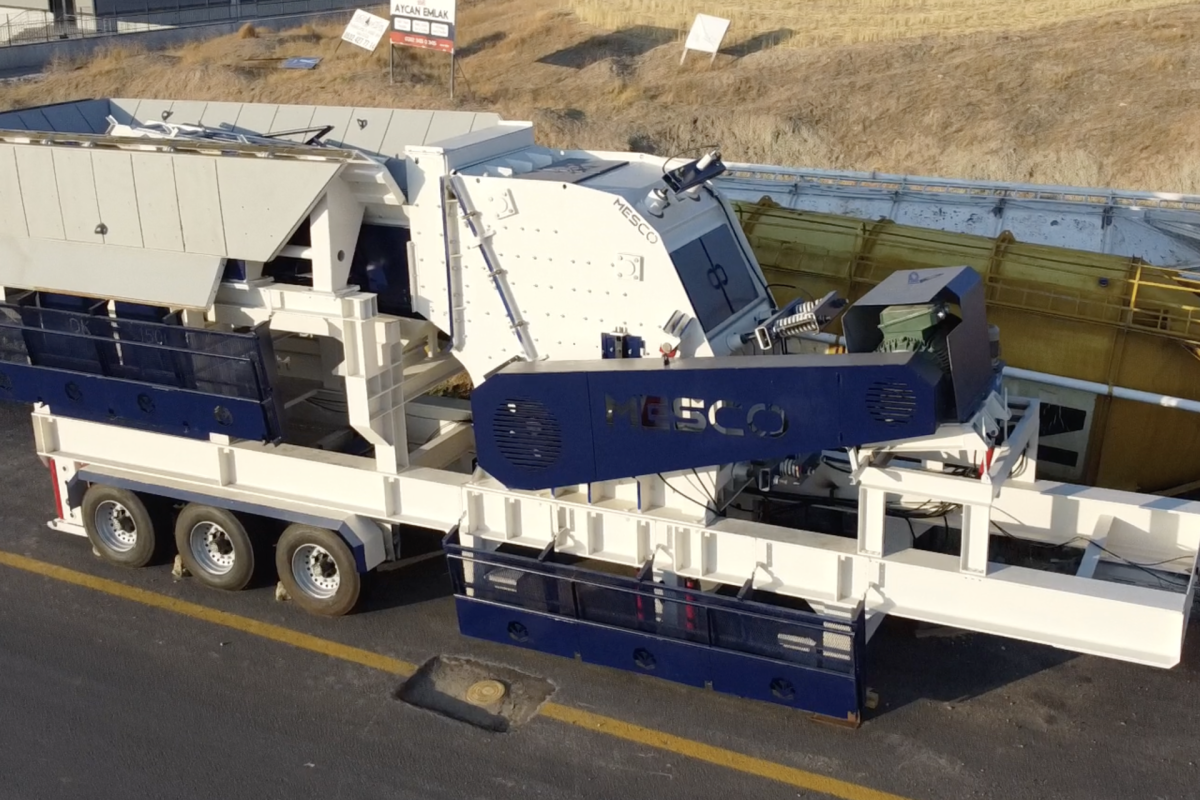
In construction, infrastructure, and mining projects, mobile crushing & screening plants are increasingly preferred thanks to their portability and quick commissioning. They are especially effective for short-term sites, multi-location operations, and on-site recycling of construction waste.
According to global market reports, the mobile crushing & screening sector is expected to show steady growth in the coming years, driven by infrastructure investments, recycling demand, and the need for flexibility on-site.
Advantages
- Portability: Easily transported between different sites.
- Fast Setup: Ready to operate within hours or days.
- Lower Initial Investment: Requires minimal civil works.
- Flexibility: Can process various materials in different conditions.
- On-site Recycling: Demolition and construction waste can be reused directly.
Applications
- Temporary construction sites and short-term projects
- Quarries and mining operations
- Road, railway, and infrastructure works
- Recycling of construction & demolition waste
Disadvantages
- Lower capacity compared to fixed plants
- Higher maintenance demand due to frequent relocation and mechanical wear
Key Factors to Consider When Choosing a Mobile Plant
- Required Capacity (t/h)
Each project requires a specific hourly output. Mobile plants usually operate in the 50 – 600 tons/hour range. For very high production, a stationary plant is often better, but for small to mid-sized projects, mobile plants provide the optimum solution.
- Feed Size and Crusher Type
- Jaw Crusher: Best for large, hard, and abrasive stones; suitable as a primary crusher.
- Cone Crusher: Efficient for secondary crushing of hard materials like granite and basalt.
- Impact Crusher: Ideal for softer to medium-hard materials and recycling; produces cubical output.
The maximum feed size (e.g., 500–800 mm) directly determines which crusher type is appropriate.
- Mobility: Wheeled (Truck-mounted) vs Tracked (Crawler)
- Wheeled:
- Lower investment cost
- Efficient on paved or firm ground
- Requires towing vehicle for relocation
- Tracked:
- Independent movement on site, no towing required
- Performs better in rough, muddy, or uneven terrain
- Higher fuel consumption and maintenance cost
- Power Source: Diesel, Electric, Hybrid
- Diesel: Independent from external power, suitable for remote sites without grid access.
- Electric: Lower operating costs and more environmentally friendly, but requires a grid connection.
- Hybrid: Can switch between diesel and electric; offers flexibility and reduced fuel costs, but has the highest initial investment.
- Maintenance Access & Wear Parts Availability
Relocating mobile plants more often leads to faster wear. Key considerations include:
- Easy access to service doors for crushers and screens
- Regular replacement of wear parts: jaw plates, mantles, hammers, screen meshes
- Belt rollers and bearings should be easy to adjust and replace
- Availability of spare parts in local stock is critical for minimizing downtime
Which Plant Is Right for You?
- For long-term, high-capacity, single-location projects: stationary plants are the best choice.
- For multi-site, short-term, and flexible projects: mobile crushing & screening plants are the ideal solution.
Conclusion — Mesco Global’s Support
When selected with the right capacity and configuration, mobile crushing & screening plants deliver high efficiency, lower logistics costs, and environmental benefits.
At Mesco Global, we provide site-specific capacity analysis, crusher & screen selection, and operating cost evaluation to ensure the best solution for your project.